
Overview #
Concrete masonry units (CMUs), or concrete blocks, are versatile and durable building blocks used for foundations, walls, and partitions. They are strong, fire-resistant, and come in various sizes, shapes, and finishes, with hollow cores often filled with rebar and grout for increased structural integrity. Foam can be installed within the cores to provide additional insulation.
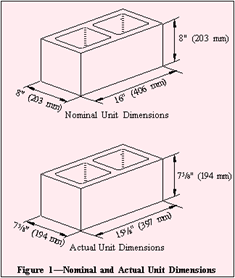
Modeling a CMU within Ekotrope is not intuitive, and until recently there has been no simple way to do it. Luckily, RESNET has published an addendum on this topic so that there is consistency across the industry. This article provides guidance to modelers on how to correctly model a CMU wall in Ekotrope.
Typical Assemblies #
There are 4 assemblies that are typically seen with CMU construction.
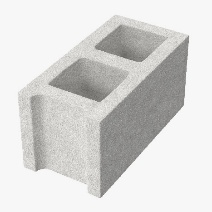
1. Hollow Core
This is just a plain concrete block with no additional insulation.
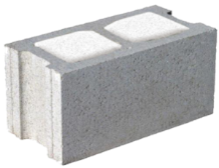
2. Foam Core
This is a concrete block where the cores are filled with foam insulation to provide additional thermal resistance.
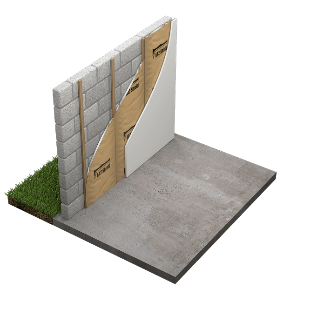
3. Additional Stud/Cavity Insulation
In some states, such as Florida, CMU wall construction is commonly paired with Fi-Foil insulation which is attached to the concrete blocks using “baby studs” which are smaller than conventional framing studs. Fi-Foil can be paired with either hollow core or foam core CMUs.
4. Additional Continuous Insulation
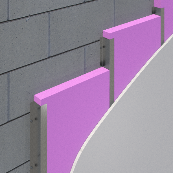
Some assemblies will not use baby studs and instead will use Z Furring Strips, which are thin pieces of metal, in between pieces of foam board insulation. This can be paired with either hollow core or foam core CMUs.
Modeling Guidance #
To model a CMU, please create a single continuous layer of concrete to represent the assembly. Additional layers can be added on either side of the block to represent other components of the wall such as continuous insulation, gypsum, siding, etc.
When determining the R-Value to use for the CMU layer, the Rater/Modeler will need to know a few key pieces of information. Inspectors should request this info from the builder or installer.
- Concrete density
- Spacing of the core pours
- If the cores are foamed or not
- Whether it’s a 2-web or 3-web CMU
- In CMU (concrete masonry unit) construction, a web is the solid internal part of a hollow block that connects the two face shells, which are the outer surfaces of the block. It separates the hollow spaces, or cells, within the block
Where all of this information has not been obtained, values for 3-web CMU with 115-pound concrete density and core pours at 48” o.c. shall be used.
With this information, the R-Value of the CMU layer shall be represented using the tables as provided by RESNET addendum 83f. See bottom of document for tables.
- When modeling a hollow core CMU, simply assign the CMU layer an R-Value according to the tables above. Block wall construction almost always has a furred cavity with an airspace and drywall on the interior side. If this furring is done with:
- Baby studs, it should be modeled as a stud/cavity layer with an insulation type of air gap if this cavity is empty.
- Z Furring Strips, the cavity should simply be modeled as an air gap layer. Make sure to model the gypsum board layer on the interior side as well.
- When modeling a foam core CMU, follow the same guidance as hollow core but using the “Foamed-in-place cores” section of the tables above to determine the R-Value.
- When modeling additional stud/cavity insulation, add it as another layer on the interior side of the CMU. Remember to add in additional layers such as the exterior finish and the interior gypsum board (fig. 1 & 2)
- When modeling additional continuous insulation, add it as another layer on the interior side of the CMU. Remember to add in additional layers such as the exterior finish and the interior gypsum board. (fig. 3)
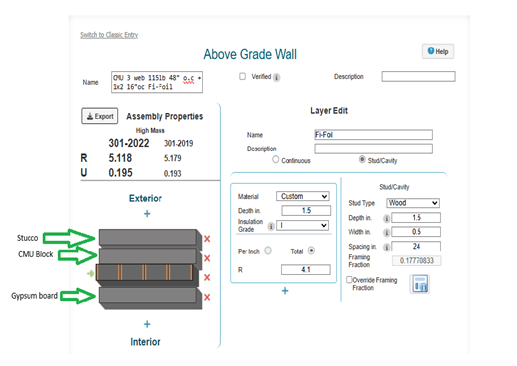
Fig. 1
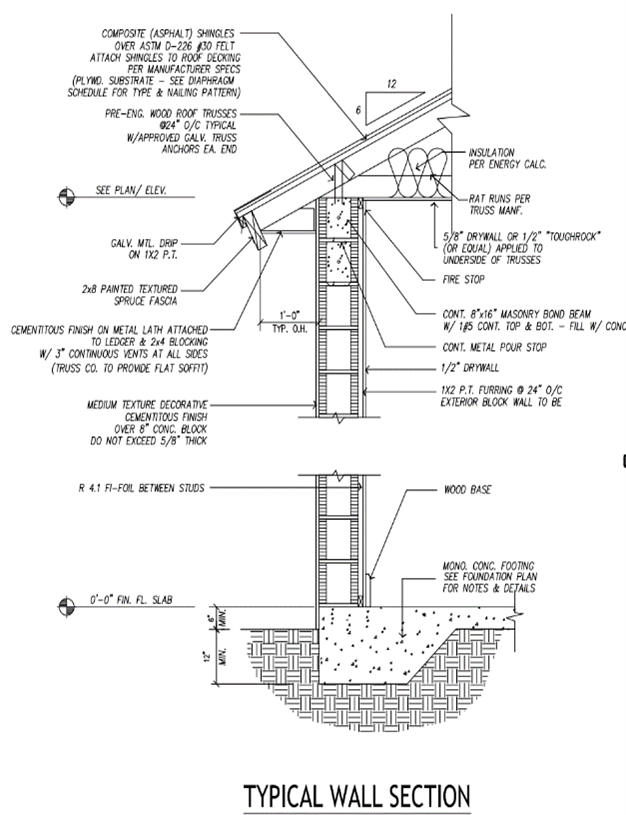
Fig. 2
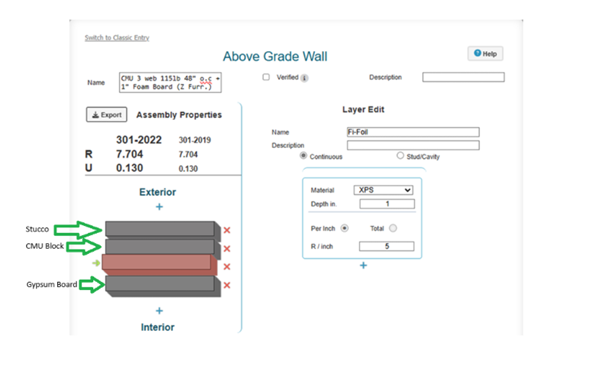
Fig. 3
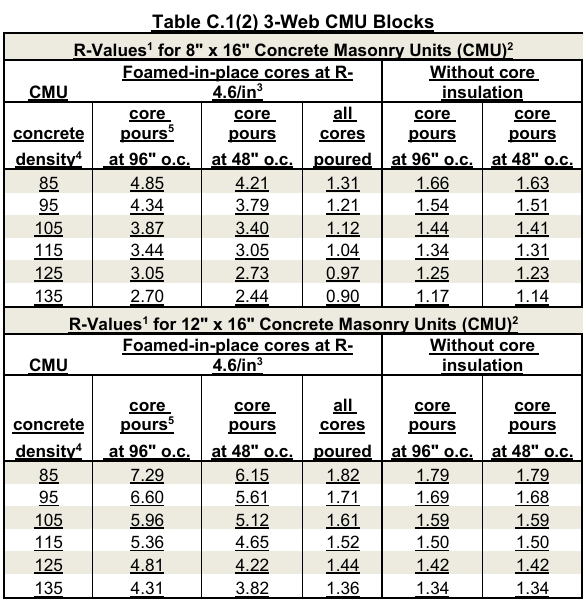
| Table Notes: |
| 1. R-Values exclude indoor and outdoor air film resistances of 0.68 and 0.17. A bond beam at 8 foot wall height is assumed. |
| 2. CMU dimensions are nominal. Subtract 3/8″ mortar joint for actual. Each CMU has 3 each 1″ web thicknesses and 2 each 1-1/4″ face thickness. |
| 3. Characteristic resistivity of pre-expanded foamed-in-place insulation. |
| 4. Concrete density units are pounds per cubic foot (lb/ft3). |
| 5. Concrete density for core pours is 140 lb/ft3. |
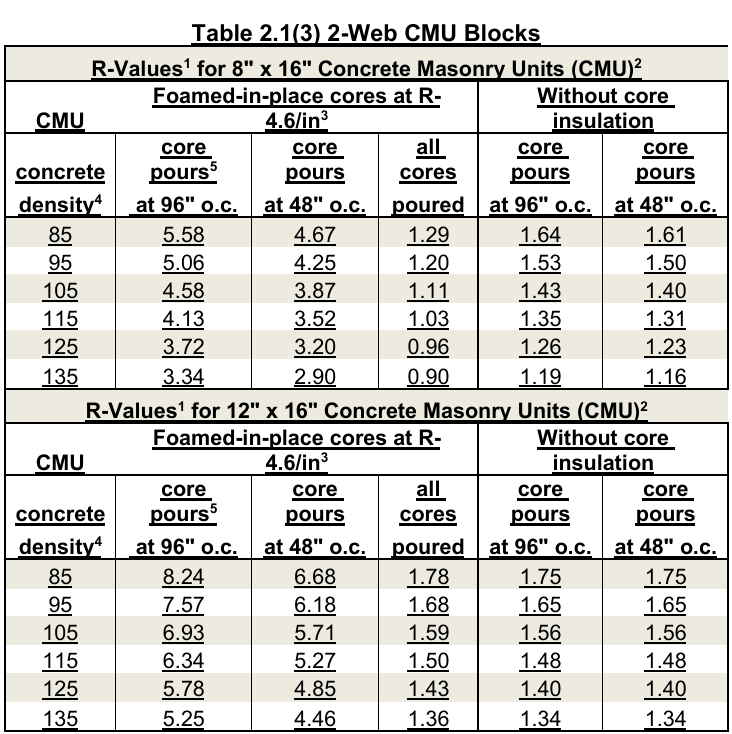
| Table Notes: |
| 1. R-Values exclude indoor and outdoor air film resistances of 0.68 and 0.17. A bond beam at 8 foot wall height is assumed. |
| 2. CMU dimensions are nominal. Subtract 3/8″ mortar joint for actual. Each CMU has 2 each 1″ web thicknesses and 2 each 1-1/4″ face thickness. |
| 3. Characteristic resistivity of pre-expanded foamed-in-place insulation. |
| 4. Concrete density units are pounds per cubic foot (lb/ft3). |
| 5. Concrete density for core pours is 140 lb/ft3. |